
What Every Landlord Needs to Know About Disability Accommodations, Fair Housing, and Assistance Animals
- Jul 23, 2026
- 21 min read
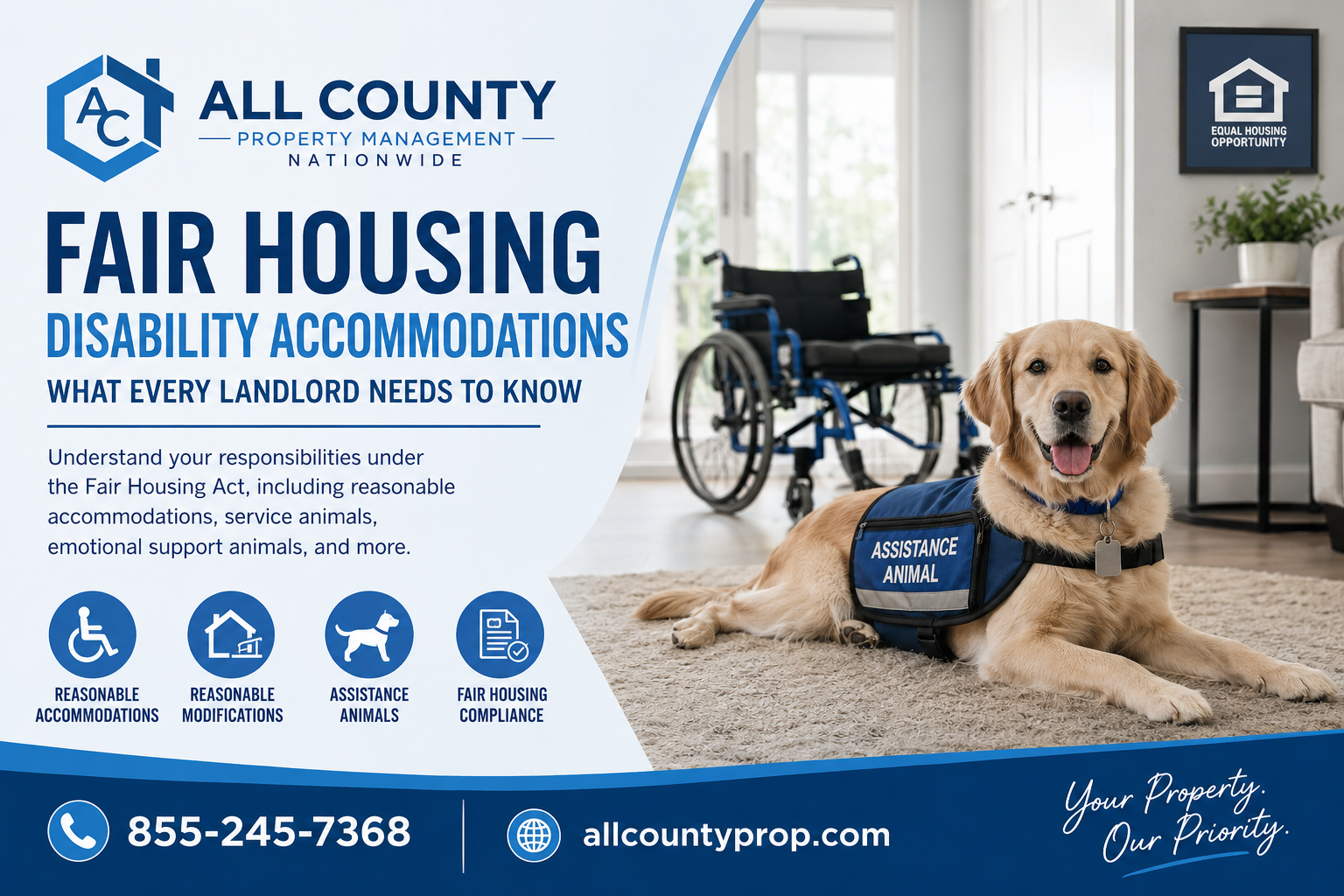

What Every Landlord Needs to Know About Disability Accommodations, Fair Housing, and Assistance Animals
Owning rental property means more than maintaining buildings and collecting rent—it also means understanding the laws that protect residents and ensure equal access to housing. Few areas of property management create more confusion for landlords than disability accommodations, particularly when requests involve service animals, emotional support animals (ESAs), reserved parking spaces, or physical modifications to a rental home.
Unfortunately, misunderstandings in this area can have significant consequences. A landlord who unintentionally violates Fair Housing laws may face costly complaints, legal fees, government investigations, and reputational damage. The good news is that most issues can be avoided by understanding your responsibilities, responding consistently, and documenting every accommodation request appropriately.
Many rental property owners mistakenly believe that the Americans with Disabilities Act (ADA) governs all rental housing. While the ADA is an important civil rights law, it generally applies to public accommodations and commercial spaces—not most residential rental properties. Instead, the Fair Housing Act (FHA) is the primary federal law governing disability-related housing protections.
Understanding the distinction between these laws is the first step toward protecting both your investment and your residents.
Whether you own a single-family rental home, a duplex, or a portfolio of investment properties, this guide will help you understand reasonable accommodations, reasonable modifications, assistance animals, and best practices for handling disability-related requests with confidence.
Table of Contents
- Understanding the ADA vs. the Fair Housing Act
- What Qualifies as a Disability?
- The Protected Class of Disability
- Reasonable Accommodations Explained
- Reasonable Modifications Explained
- The Interactive Process
- Service Animals vs. Emotional Support Animals
- Assistance Animals Under Fair Housing
- Documentation Requirements
- Pet Fees and Deposits
- Common Landlord Mistakes
- Frequently Asked Questions
- Landlord Best Practices
- When Professional Property Management Can Help
Why This Matters for Every Landlord
Federal Fair Housing laws exist to ensure that individuals with disabilities have equal access to housing opportunities. Compliance isn’t simply about avoiding lawsuits—it’s about treating prospective tenants and current residents fairly while creating policies that are applied consistently.
Many accommodation requests are straightforward and inexpensive. Others require thoughtful evaluation and documentation. The key is knowing when an accommodation is legally required, what questions you may ask, and how to properly respond.
Experienced property managers deal with these situations regularly. Individual landlords, however, may only encounter them occasionally, making it easy to unintentionally make decisions based on assumptions instead of the law.
Education is one of the best tools landlords have to reduce risk.
It is important to understand that the Fair Housing Act—not the ADA—is the primary federal law governing most residential rentals.
Understanding the Difference Between the ADA and the Fair Housing Act
One of the biggest misconceptions in residential property management is that the ADA governs rental housing. While both the ADA and the Fair Housing Act protect individuals with disabilities, they serve different purposes.
The Americans with Disabilities Act (ADA)
The Americans with Disabilities Act was enacted in 1990 to prohibit discrimination against individuals with disabilities in employment, public services, transportation, telecommunications, and places of public accommodation.
Examples include:
- Restaurants
- Retail stores
- Hotels
- Banks
- Government buildings
- Schools
- Commercial office buildings
Within apartment communities, the ADA may apply to areas that are open to the public, such as:
- Leasing offices
- Public restrooms
- Public parking serving the leasing office
However, the interiors of most residential rental units are generally not governed by the ADA.
The Fair Housing Act (FHA)
Residential landlords instead operate primarily under the Fair Housing Act.
The Fair Housing Act prohibits housing discrimination based on:
- Race
- Color
- Religion
- National origin
- Sex
- Familial status
- Disability
The law requires housing providers to make reasonable accommodations and, in many circumstances, permit reasonable modifications so qualified individuals with disabilities have an equal opportunity to use and enjoy their homes.
For landlords, property managers, leasing agents, and rental owners, the Fair Housing Act is the law that most frequently governs disability accommodation requests.
State and Local Laws May Go Even Further
Federal law establishes minimum protections, but many states and municipalities provide additional rights.
Some states expand disability protections by:
- Broadening the definition of disability
- Providing additional protections for assistance animals
- Creating stricter response deadlines
- Establishing additional landlord responsibilities
Because these laws vary, landlords should understand the requirements applicable in their state and municipality before making decisions regarding accommodation requests.
Not familiar with some of the legal or property management terminology used in this article? Our Rental Property Glossary of Terms explains the most common leasing, maintenance, and Fair Housing terms every rental property owner should understand.
What Qualifies as a Disability?
The Fair Housing Act defines disability broadly.
Generally, a disability is a physical or mental impairment that substantially limits one or more major life activities.
Major life activities include things like:
- Walking
- Seeing
- Hearing
- Speaking
- Breathing
- Learning
- Working
- Caring for oneself
- Performing manual tasks
Disabilities may be visible or invisible.
Examples include:
Physical Disabilities
- Blindness
- Hearing impairments
- Multiple sclerosis
- Cerebral palsy
- Paralysis
- Mobility impairments
- Muscular dystrophy
Chronic Medical Conditions
- Diabetes
- Epilepsy
- Cancer
- Heart disease
Mental and Emotional Disabilities
- PTSD
- Anxiety disorders
- Major depression
- Bipolar disorder
- Autism spectrum disorders
- Intellectual disabilities
The important point for landlords is this:
You are not responsible for determining whether someone “looks disabled.”
Many qualifying disabilities are completely invisible.
Making assumptions—or dismissing a request because someone appears healthy—can create Fair Housing problems.
Disability Is a Protected Class
Under the Fair Housing Act, disability is one of the protected classes.
That means landlords may not:
- Refuse to rent because someone has a disability.
- Charge higher rent because of a disability.
- Offer different lease terms.
- Discourage applicants from applying.
- Harass or retaliate against someone requesting an accommodation.
- Apply policies differently because someone has a disability.
Fair Housing is built on one simple principle:
Equal opportunity—not identical treatment.
Sometimes equal opportunity requires making reasonable exceptions to standard policies.
Understanding Reasonable Accommodations
A reasonable accommodation is a change to a rule, policy, practice, or procedure that allows an individual with a disability an equal opportunity to use and enjoy their housing.
Notice what is changing.
The landlord is changing a rule—not necessarily the property itself.
Reasonable accommodations often cost little or nothing.
Examples include:
- Assigning an accessible parking space closer to the resident’s unit.
- Allowing rent payments through an alternate method because of a disability.
- Permitting a live-in aide when medically necessary.
- Allowing communication by email instead of telephone.
- Providing documents in accessible formats when appropriate.
- Allowing an approved assistance animal in a property with a no-pets policy.
The purpose is not to give special treatment.
It is to remove barriers that prevent someone from having equal access to housing.
What Makes an Accommodation “Reasonable”?
Not every request must automatically be granted.
Instead, landlords should ask:
- Is the request related to the person’s disability?
- Does it help provide equal use and enjoyment of the property?
- Would approving it create an undue financial or administrative burden?
- Would it fundamentally alter the nature of the housing operation?
Most accommodation requests are relatively simple.
Many require only a small adjustment to an existing policy.
Examples of Reasonable Accommodations
Reserved Parking
A resident with limited mobility requests a designated parking space closer to their front door.
Granting that request may be a reasonable accommodation if it allows the resident equal access to their home.
Communication Preferences
A resident with a hearing impairment asks that maintenance updates be sent by email rather than telephone.
Changing communication methods is often a reasonable accommodation.
Live-In Caregiver
An elderly resident with a qualifying disability requests permission for a live-in caregiver who is not listed on the original lease.
Allowing the caregiver may be appropriate when supported by a disability-related need.
Policy Exceptions
Some residents may need exceptions to standard community policies because of a disability.
Each request should be evaluated individually rather than denied automatically.
Why Consistency Matters
One of the biggest mistakes landlords make is responding emotionally or inconsistently.
If one resident receives careful consideration while another receives an immediate denial without review, it can create the appearance of discrimination.
The best property managers rely on written procedures, consistent documentation, and objective decision-making.
Treat every request with professionalism.
Respond promptly.
Keep thorough records.
And remember that every accommodation request deserves an individualized review rather than a one-size-fits-all answer.
For additional guidance on reasonable accommodations, reasonable modifications, and assistance animals, visit the U.S. Department of Housing and Urban Development’s Fair Housing resources.
Reasonable Modifications, the Interactive Process, and Assistance Animals
Understanding Reasonable Modifications
While a reasonable accommodation changes a rule or policy, a reasonable modification involves making a physical change to the property so a resident with a disability can fully use and enjoy their home.
This distinction is important because landlords often confuse the two terms. An accommodation changes how something is done, while a modification changes the property itself.
Examples of reasonable modifications may include:
- Installing grab bars in a bathroom
- Adding a wheelchair ramp
- Widening doorways for wheelchair accessibility
- Lowering light switches or countertops
- Installing lever-style door handles
- Replacing round doorknobs with accessible hardware
- Modifying a shower for wheelchair access
Many of these improvements can significantly improve a resident’s quality of life while allowing them to remain safely in their home.
Who Pays for a Reasonable Modification?
One of the first questions landlords ask is, “Who is responsible for paying?”
The answer depends on several factors, including the type of housing, the funding associated with the property, and applicable federal, state, and local laws.
In many privately owned rental properties, residents requesting a reasonable modification may be responsible for the cost of the modification. However, there are important exceptions, particularly for housing receiving federal financial assistance or where state or local laws impose additional requirements.
Landlords should never assume the resident—or the landlord—is automatically responsible. Instead, review the applicable laws and, when necessary, consult experienced legal counsel or a knowledgeable property management professional before making a decision.
Another common concern is whether a resident must restore the property when they move out. In some situations, restoration may be appropriate if the modification would interfere with the next resident’s use of the property. However, many accessibility improvements add value and may be left in place.
The Interactive Process
Perhaps the most overlooked aspect of Fair Housing compliance is what is commonly referred to as the interactive process.
While the Fair Housing Act does not prescribe a rigid step-by-step procedure, housing providers are expected to engage in a meaningful dialogue with residents when evaluating accommodation requests.
The goal is not to immediately approve or deny a request. The goal is to understand the request, gather appropriate information when necessary, and make a thoughtful, individualized decision.
Ignoring a request or failing to respond can be just as problematic as issuing an improper denial.
Step 1: Receive the Request
A resident does not need to complete a special form or use legal terminology to request an accommodation.
In many cases, a request may be as simple as:
“Because of my disability, I need a parking space closer to my apartment.”
Or:
“My doctor has recommended an emotional support animal.”
Even casual conversations can constitute accommodation requests.
Train yourself and your staff to recognize when a resident may be asking for an accommodation.
Step 2: Respond Promptly
Time matters.
Accommodation requests should never sit unanswered for weeks while someone decides what to do.
Even if additional documentation is needed, acknowledge receipt of the request and let the resident know you are reviewing it.
Prompt communication demonstrates professionalism and helps establish that you are acting in good faith.
Step 3: Determine Whether Additional Information Is Needed
If both the disability and the need for the accommodation are readily apparent, additional documentation generally is not necessary.
For example:
A resident who uses a wheelchair requests an accessible parking space near the entrance.
The disability and the need are obvious.
Additional documentation may not be appropriate.
However, if the disability or the disability-related need is not apparent, landlords may request reliable information supporting the accommodation request.
The key word is reliable.
The request should focus only on information necessary to evaluate the accommodation.
What Landlords Should NOT Ask
Many Fair Housing complaints arise because landlords ask inappropriate questions.
Generally, landlords should not request:
- Medical records
- A specific diagnosis
- Prescription information
- Treatment history
- Detailed medical files
- Information unrelated to the requested accommodation
Remember:
You are evaluating the accommodation—not diagnosing the resident.
Respecting privacy is an important part of Fair Housing compliance.
Step 4: Evaluate Each Request Individually
There is no universal checklist that automatically approves or denies accommodation requests.
Each situation should be evaluated based on its own facts.
Ask yourself:
- Is there a qualifying disability?
- Is the request related to that disability?
- Will the request allow equal use and enjoyment of the property?
- Would granting the request fundamentally alter the housing operation?
- Would the request create an undue financial or administrative burden?
Avoid making decisions based on assumptions, stereotypes, or personal opinions.
Consistency is one of the strongest protections a landlord has.
Service Animals vs. Emotional Support Animals
Few Fair Housing topics generate as much confusion as assistance animals.
Many people use the terms service animal, emotional support animal, and assistance animal interchangeably, but they have different meanings under federal law.
Understanding those differences is essential.
What Is a Service Animal?
Under the Americans with Disabilities Act, a service animal is generally a dog that has been individually trained to perform specific tasks for a person with a disability.
Examples include:
- Guiding someone who is blind
- Alerting an individual who is deaf
- Detecting seizures
- Alerting someone to dangerous blood sugar changes
- Retrieving dropped items
- Assisting with balance or mobility
- Interrupting certain psychiatric symptoms through trained tasks
The emphasis is on specific training that directly assists with the individual’s disability.
What Is an Emotional Support Animal?
An Emotional Support Animal (ESA) provides comfort or emotional support that helps alleviate one or more symptoms of a person’s disability.
Unlike service animals, ESAs are not required to receive specialized task training.
Their benefit comes from their presence and the emotional support they provide.
Because of this distinction, emotional support animals are generally not considered service animals under the ADA.
However, that does not mean they are excluded from housing protections.
Assistance Animals Under the Fair Housing Act
Under Fair Housing guidance, both trained service animals and many emotional support animals fall under the broader category of assistance animals.
An assistance animal is not considered a pet.
Instead, it is an animal that performs work, provides assistance, or offers emotional support that alleviates one or more symptoms or effects of a person’s disability.
This distinction is important because landlords sometimes make decisions based solely on whether an animal has formal training.
Under Fair Housing laws, that is not the proper analysis.
The question is whether the resident has a qualifying disability and whether there is a disability-related need for the animal.
“No Pets” Does Not Automatically Mean “No Assistance Animals”
Many landlords proudly advertise “No Pets.”
That policy may still require an exception.
If a resident qualifies for an assistance animal under Fair Housing laws, allowing that animal may be a reasonable accommodation—even when pets are otherwise prohibited.
This is one of the most common areas where landlords unintentionally violate Fair Housing laws.
Policies should always be flexible enough to accommodate lawful exceptions.
Can Landlords Charge Pet Fees?
Because approved assistance animals are not considered pets, landlords generally may not charge:
- Pet rent
- Pet deposits
- Non-refundable pet fees
- Monthly pet charges
However, this does not mean residents are excused from responsibility.
Residents remain financially responsible for actual damage caused by the animal beyond normal wear and tear.
Treating an assistance animal differently from a pet is an important Fair Housing principle.
Breed, Size, and Weight Restrictions
Many rental communities have breed or weight restrictions for pets.
Those restrictions generally do not automatically apply to approved assistance animals.
Instead, requests should be evaluated individually.
A housing provider should avoid relying on generalized assumptions about certain breeds or species and instead consider the specific facts of each situation.
Online Certificates and Registration Websites
The internet is filled with websites offering instant emotional support animal certificates, identification cards, registration numbers, and laminated badges.
These documents often create confusion for both landlords and residents.
HUD guidance makes clear that the existence of an online certificate or registration does not automatically establish that an individual is entitled to an accommodation.
Likewise, the absence of a certificate does not automatically mean the request should be denied.
Landlords should focus on whether there is reliable information supporting the disability-related need for the requested accommodation—not whether someone purchased an identification card online.
To better understand your rights and responsibilities under federal law, review the official Fair Housing Act guidance provided by HUD’s Office of Fair Housing and Equal Opportunity.
Real-World Example
Imagine this situation:
A prospective tenant applies for a rental home that has a strict “No Pets” policy.
During the application process, the tenant explains they have an emotional support animal prescribed as part of treatment for a qualifying disability.
Rather than immediately denying the application because of the pet policy, the landlord should evaluate the request as a potential reasonable accommodation under the Fair Housing Act.
If appropriate supporting documentation is provided when permitted, and no lawful basis exists to deny the request, the landlord may need to allow the assistance animal despite the property’s no-pets policy.
Handling situations like this professionally and consistently helps reduce legal risk while ensuring qualified individuals have equal access to housing.
Still have questions about assistance animals? Read our comprehensive guide, Service Animals vs. Emotional Support Animals: What Every Landlord and Tenant Should Know, for a deeper look at the differences and your responsibilities under Fair Housing laws.
Best Practices, Frequently Asked Questions, and Protecting Your Investment
When Can a Landlord Deny an Accommodation Request?
One of the biggest misconceptions among landlords is that every accommodation request must automatically be approved. That is not the case. The Fair Housing Act requires landlords to consider reasonable accommodation requests individually, but there are circumstances where a request may legally be denied.
An accommodation request may be denied if:
- It would create an undue financial or administrative burden on the housing provider.
- It would fundamentally alter the nature of the landlord’s business operations.
- There is insufficient reliable information to establish that the request is related to a qualifying disability when such information may appropriately be requested.
- The specific accommodation requested is not necessary to provide the individual with an equal opportunity to use and enjoy the dwelling.
- The individual or assistance animal poses a direct threat to the health or safety of others that cannot be reduced or eliminated through another reasonable accommodation.
Every denial should be carefully documented and based on the facts of the specific situation—not assumptions, stereotypes, or generalized fears.
When in doubt, consult qualified legal counsel or an experienced property management company before denying a request.
Documentation Is Your Best Protection
Proper documentation protects both the landlord and the resident.
Whenever an accommodation request is received, create a written record that includes:
- The date the request was received.
- A summary of the request.
- Any communications with the resident.
- Documentation received, if applicable.
- The evaluation process.
- The final decision.
- The date the resident was notified.
Good documentation demonstrates that every request was handled professionally, consistently, and fairly.
Should a Fair Housing complaint ever arise, your records may become one of your strongest defenses.
Common Fair Housing Mistakes Landlords Make
Most Fair Housing complaints stem from misunderstanding the law rather than intentional discrimination. By recognizing common mistakes, landlords can reduce their risk considerably.
Mistake #1: Treating Everyone Exactly the Same
Fair Housing does not always require identical treatment.
Sometimes equal housing opportunities require reasonable exceptions to standard policies.
Consistency means evaluating every request under the same process—not giving every resident the exact same answer.
Mistake #2: Automatically Denying Assistance Animals
Many landlords immediately deny an emotional support animal because the property has a “No Pets” policy.
Remember, approved assistance animals are not pets under Fair Housing guidance.
Automatic denials can create significant legal exposure.
Mistake #3: Asking Too Many Medical Questions
Landlords often believe they need to understand a resident’s medical condition before making a decision.
They do not.
Your role is to evaluate the accommodation request—not investigate someone’s health.
Respect privacy and request only information that is appropriate under Fair Housing guidance.
Mistake #4: Delaying a Decision
Ignoring a request or allowing it to sit unanswered for weeks can create unnecessary problems.
Even if additional information is needed, acknowledge the request promptly and communicate with the resident throughout the process.
Mistake #5: Making Decisions Based on Emotion
Accommodation requests occasionally surprise landlords.
Instead of reacting emotionally, follow your written procedures.
Professionalism and consistency should always guide your decisions.
Frequently Asked Questions
Can I Ask a Tenant About Their Disability?
You may ask for reliable information supporting a disability-related accommodation when the disability or need is not readily apparent. However, you generally should not request detailed medical records, diagnoses, or treatment histories.
Can I Require an Emotional Support Animal to Have Special Training?
No.
Unlike service animals, emotional support animals are not required to receive specialized training.
Can I Charge Pet Rent for an Assistance Animal?
Generally, no.
Approved assistance animals are not considered pets under Fair Housing guidance.
However, residents remain responsible for damage caused by the animal beyond normal wear and tear.
What If Another Resident Has Allergies?
Both situations deserve consideration.
The existence of another resident’s allergies does not automatically justify denying an accommodation request.
Landlords should evaluate both circumstances individually and seek reasonable solutions whenever possible.
What If the Animal Causes Damage?
Residents remain responsible for actual damage caused by their assistance animals, just as they would be responsible for any other damage they cause during their tenancy.
What If the Request Is Made After Move-In?
Accommodation requests may occur at any point during a tenancy.
A resident is not required to disclose a disability during the application process in order to request an accommodation later.
Can I Require an Assistance Animal to Be Registered?
No.
There is no official federal registration for service animals or emotional support animals.
Decisions should be based on Fair Housing guidance—not registration certificates or online databases.
Landlord Accommodation Checklist
Whenever you receive an accommodation request, follow these steps:
✅ Listen carefully to the request.
✅ Respond promptly.
✅ Determine whether the disability-related need is readily apparent.
✅ Request reliable supporting information only when appropriate.
✅ Evaluate the request individually.
✅ Document every communication.
✅ Respond in writing.
✅ Maintain all records.
✅ Seek professional guidance if uncertain.
Having a written process not only improves consistency but also demonstrates your commitment to Fair Housing compliance.
Fair Housing Compliance Is Good Business
While many landlords focus on avoiding lawsuits, Fair Housing compliance offers benefits beyond legal protection.
Professional, consistent housing practices can:
- Improve resident satisfaction.
- Reduce misunderstandings.
- Increase resident retention.
- Enhance your reputation.
- Reduce disputes.
- Protect your long-term investment.
When residents feel they are treated fairly and respectfully, relationships are often stronger and communication improves.
Professional Property Management Makes a Difference
Fair Housing compliance is one of the many reasons rental property owners choose professional property management.
An experienced property manager stays current on changing federal, state, and local housing regulations, maintains consistent documentation, and helps ensure accommodation requests are evaluated fairly and professionally.
This reduces risk for property owners while providing residents with knowledgeable, responsive service.
For landlords managing multiple properties—or even a single investment home—the peace of mind that comes from working with experienced professionals can be invaluable.
If you own rental property and want to reduce legal risk while maximizing your investment, All County Property Management is here to help. With locally owned offices nationwide, our experienced teams understand Fair Housing compliance, resident relations, and the day-to-day responsibilities that come with successful rental ownership.
Find an All County Property Management office near you at allcountyprop.com or call us at 855-245-7368 to learn how professional property management can help protect your investment.
Final Thoughts
Understanding disability accommodations is not about memorizing every regulation—it’s about developing a fair, consistent process that respects residents while protecting your investment.
The Fair Housing Act requires landlords to evaluate requests thoughtfully, communicate professionally, and avoid making assumptions based on disabilities or assistance animals.
By learning the difference between reasonable accommodations and reasonable modifications, understanding how assistance animals are treated under Fair Housing laws, and documenting every request carefully, landlords can significantly reduce their legal risk while creating housing opportunities that are fair and accessible for everyone.
No landlord is expected to know every legal nuance. However, every landlord is responsible for recognizing when a request may involve Fair Housing protections and taking the appropriate steps to evaluate it.
When questions arise, don’t guess. Seek guidance from experienced property management professionals or qualified legal counsel. A thoughtful decision today can prevent an expensive legal dispute tomorrow while reinforcing your commitment to professional, ethical property management.
Disclaimer
This article is provided for educational purposes only and should not be construed as legal advice. Fair Housing requirements may vary based on federal, state, and local laws. Landlords should consult qualified legal counsel or an experienced property management professional regarding specific accommodation requests or legal compliance questions.
Ready to hire a
property manager?
With 88 locations across the U.S. servicing more than 30,000 residential properties, our experts are ready to help provide the best property management experience.
Find a Property Manager